

Reference
Leather glossary: upholstery leather terms explained
This glossary defines 38 leather and upholstery terms in plain English, from aniline, full-grain and top-grain to tanning, yield, patina and PU. It is a general industry reference for architects, interior designers and furniture makers, and links to HideItalia's detailed guides where a term needs more explanation.
What do common leather terms mean?
Leather has its own vocabulary, and suppliers do not always use it in exactly the same way. If a term on a quotation or specification is unclear, ask your supplier to explain it. These definitions are general industry usage.
- Aniline leather
- Leather dyed with soluble dyes and finished with little or no surface pigment, so the natural grain and markings remain visible. It feels soft and natural but is generally more sensitive to liquids and light.
- Abrasion resistance
- How well a leather surface withstands rubbing and wear, usually measured in a laboratory test. It is one of the performance measures requested for upholstery.
- Bicast leather
- A split leather coated with a polyurethane layer, then embossed with a grain pattern. It contains real leather fibres but behaves differently from a grain leather.
- Bonded leather
- A material made from leather scraps and fibres combined with a binder and a surface coating, rather than from a whole hide.
- Butt
- The back and upper hind part of a hide, generally the thickest and most uniform area, valued for its consistency.
- By-product
- A material produced as a secondary output of another industry. Hides are a by-product of the meat industry, which is the basis of the argument that tanning gives them a use.
- Chrome tanning
- Tanning with chromium salts. It is fast, produces soft and consistent leather, and is widely used for upholstery.
- Colour fastness
- The resistance of a leather's colour to fading or transfer from light, rubbing, sweat or water. It is tested to standard methods.
- Corrected-grain leather
- Leather whose surface has been sanded to remove imperfections and finished with an embossed artificial grain, giving a uniform appearance.
- Crust
- Leather that has been tanned and dried but not yet fully finished or coloured, the stage before finishing.
- Cut edge
- The exposed edge of a piece of leather where it has been cut. On real leather it shows a fibrous structure.
- Embossing
- Pressing a pattern, such as a grain, into the leather surface under heat and pressure.
- Finish
- The surface treatment applied after tanning and dyeing, such as dyes, pigments and topcoats, which sets colour, sheen, feel and protection.
- Flesh side
- The underside of a hide, which faced the animal's flesh. It has a fibrous, suede-like texture.
- Full-grain leather
- Leather that keeps its natural grain surface intact, without sanding or buffing to remove marks.
- Genuine leather
- A term used in many markets for real leather, often of lower or unspecified grade. It does not by itself indicate quality.
- Grain
- The outer surface of a hide, with its natural pattern of pores, and the strongest part of the hide.
- Hide
- The skin of a large animal, such as a cow or buffalo, used to make leather. Smaller animals such as sheep and goats give skins.
- Hand
- The way leather feels to the touch, including its softness, firmness and suppleness.
- Light fastness
- The ability of a colour to resist fading when exposed to light.
- Nap
- The short raised fibre surface on suede and nubuck leather, which looks different depending on the direction it is brushed.
- Nubuck
- Grain leather lightly sanded or buffed on the grain side to produce a soft, fine velvety surface.
- Patina
- The soft change in colour and sheen that natural leather develops with use and age.
- Pigmented leather
- Leather finished with an opaque pigment coating, giving even colour and a more durable, easier to clean surface.
- PU leather
- A synthetic material of polyurethane coated onto a fabric backing and embossed to resemble leather. It contains no hide.
- Retanning
- Further treatment after the main tanning, using additional agents to adjust properties such as softness, fullness and dye uptake.
- Rexine
- A common Indian name for artificial leather, generally a coated fabric. It is a synthetic material, not leather.
- Semi-aniline leather
- Leather dyed like aniline but with a light protective topcoat, balancing natural look with extra resistance to marks.
- Sheen
- The amount of gloss or shine on the leather surface, set largely by the finish.
- Split leather
- Leather made from the lower layer of a hide that has been divided into layers. It lacks the dense natural grain and is often coated or finished.
- Square foot (sq ft)
- The common unit in which leather is sold and measured in India. Hide area is measured by machine because hides have natural, irregular shapes.
- Suede
- Leather with a soft napped surface, usually made from the flesh side or from the underside of a split.
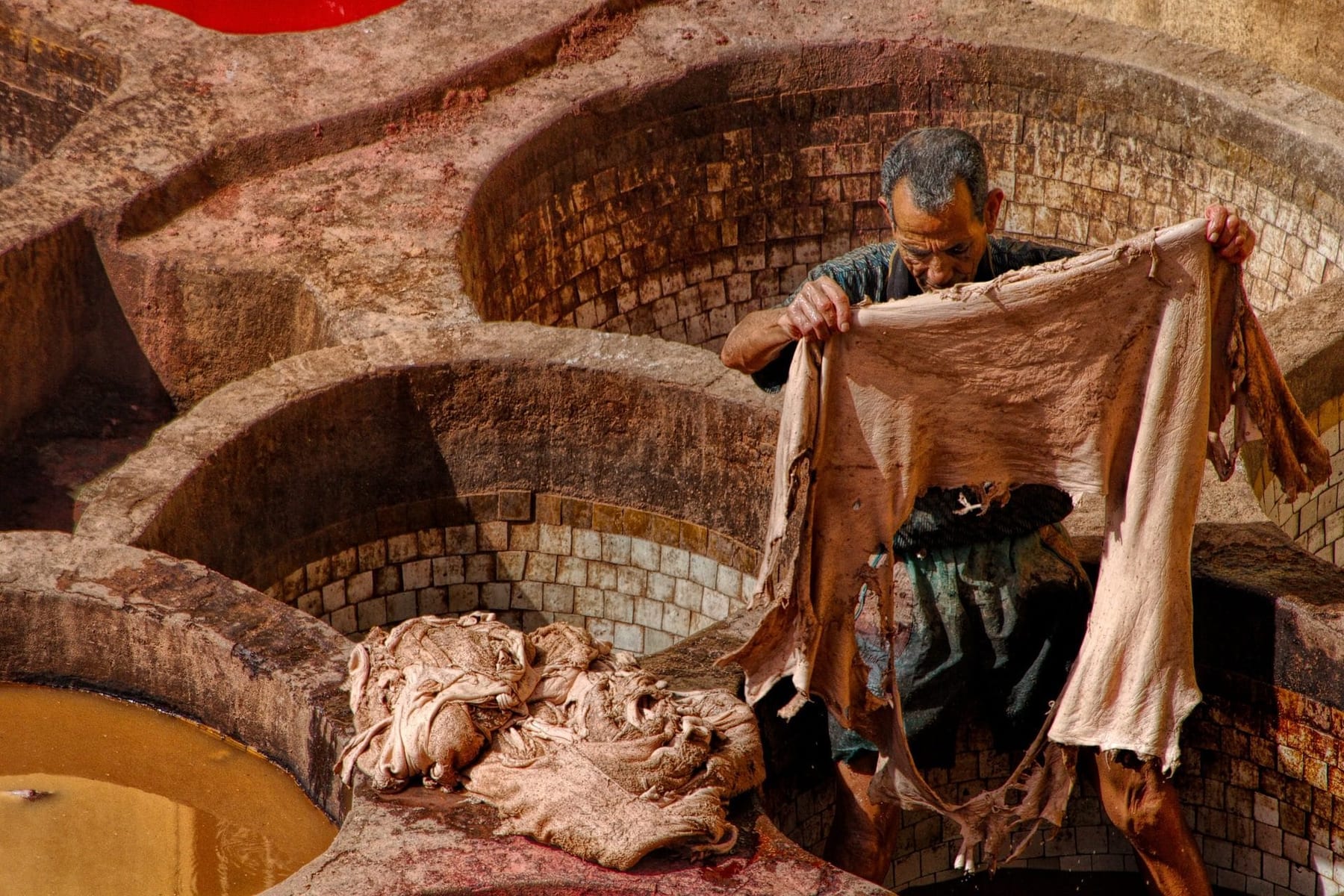
- Tanning
- The process of converting raw hide into stable, durable leather that does not rot, by treating it with tanning agents.
- Tannery
- A factory where raw hides are processed into leather, including cleaning, tanning, dyeing and finishing.
- Thickness
- How thick the leather is, typically measured in millimetres. Different uses require different thicknesses.
- Top-grain leather
- Leather in which the outer surface has been lightly sanded or buffed to reduce marks, then finished.
- Vegetable tanning
- Tanning with natural plant tannins. It is slower than chrome tanning and tends to give firmer leather that develops patina.
- Yield
- The share of a hide that ends up in the finished product after allowing for defects, edges and layout waste.
Where can I learn more about these terms?
For how the surface of a hide is treated, read about full-grain, top-grain and corrected-grain leather and aniline, semi-aniline and pigmented finishes. For how leather is made, see the history of tanning.
Frequently asked questions
01What is the difference between a hide and a skin?
In the trade, 'hide' usually means the skin of a large animal such as a cow or buffalo, while smaller animals such as sheep and goats give 'skins'.
02What does grain mean in leather?
Grain is the outer surface of the hide, with its natural pattern of pores. It is the strongest part of the hide.
03Is rexine real leather?
No. Rexine is a common name in India for artificial leather, a coated fabric with no animal hide.
04What is tanning?
Tanning converts raw hide into stable, durable leather that does not rot, using agents such as chromium salts or plant tannins.
Still unsure about a term?
Ask the HideItalia leather helpline, however simple or technical your question is.